
What you can expect
Sometimes clients like to change their minds about the overall direction of their papers for various reasons. During the SOP consult talking to the client thoroughly enough so that this doesn’t happen will make everyone’s lives easier.
As mentioned in earlier articles, our clients can be a little guarded and they sometimes find it difficult to voice their opinions – they’ll often hold it in and let it out later. Sometimes that can take on the form of wanting to change directions with their personal statement in the works.
Building trust with them and listening to them while encouraging them to speak up their opinions during the consult can help lower these incidences.
It’s also quite common for an SOP to not be ready. And, when they do have, 50% of those will be from last years applications. Regardless if they have a ready SOP or not, it’s very important not to trust it.
Objectives when meeting with the client
After the call you should aim to have:
- A solid grasp and understanding of the client
- A good SOP flow agreed upon – don’t put to much weight onto the previous SOP
- A challenge that can be inclued – where the client has overcome a hardship. Avoid sob stories!
- Be able to paint a picture of a person that is their own person
- Your main challenge will be to get clients to open up, so take time to introduce yourself
- A client that is aware they need to be as honest as possible to help you show them in the best light
Remember a SOP should serve a purpose, make sure nothing is included that is redundant. A lot of clients are well off in India – they haven’t had many hardships, and will be guarded. Client will also often have common themes that they want to run with, yet are irrelevant.
Here are Some questions you can ask the client for the purpose of gathering information for the SOP:
- Did you ever have to against your parents or family to make a decision
- What are some of the most interesting experiences you’ve had
- What are any objectives/hardships you’ve overcome
- Did you’re parents go through any hardships to help you get to where you are
- Tell me about your US experience
Things that are best to avoid writing about
- Often as a child I would do crafts, profession that would use my hands etc – it’s too common and is not really relevant.
- When I was young I had treatment etc … again not the best
- Most prestigious school – cut it, everyone claims this so the word carries no weight.
- Stories about kids – sensitive topic **
- Clients who come over because they got married – take it out or make it the candidates decision, i.e don’t say its arranged or that she came over because she was married.
Talk with the client about their lives, and dig deeper. It might be a little startling to the client as it will be a lot different from the above stories, however, the client may need convincing that this is the right way to go
Side Note: There are no rules, so don’t keep things in chronological order, just keep it interesting and at 5000 words, or under (including spaces)
* * They want to know about the client as a whole, not so much their family. We don’t want to focus on it.
SOP Guidelines for Editors
Writing an effective Statement of Purpose (SOP) is challenging for many reasons, and for our international clients it can be intimidating. To answer the question, “Why dentistry?” in a simple document that captures the reader’s attention whilst walking the fine line between arrogant self-promotion and self-deprecation in a foreign language is admittedly difficult. Though many resources and professional societies encourage applicants to shy away from professional writing/editing services, they fail to understand the immense obstacle international applicants face. Herein lies the value of the service you will provide to these ambitious and successful applicants, and makes the quality of the final product a priority. In this document, we will explore what makes a statement of purpose successful to help drive your client edits.
Thinking globally, writing is a process that takes many forms and no form can be said to be 100% correct. Unlike grammar and its strict protocols writing is an expression- an art form. Typically, what we receive from our clients as an initial document is an iteration (complicated by translation) of the history and images they are attempting to portray to the reader. This image is often not overtly obvious to the other party, however. Frequently the SOP becomes a reiteration of their CV with particular emphasis on aspects they want to highlight. As an editor, your job is to find those aspects and expand on them to create a weaving story that ties together different factors answering the questions dental schools are asking. Getting stuck in the weeds, however, is a common stumbling block for people editing these types of documents. If this sounds familiar, don’t fear- there are ways to prevent this.
There are five aspects of SOP editing that will elevate your editing above the weeds. For every SOP that comes across your desk, you should aim to apply these principles.
1) Surveying the Scene
2) Seeking Themes
3) Weaving Passion
4) Relating Experience
5) Global Perspective
Let’s take a case example and break down how to build the statement of purpose our clients deserve. Throughout the remainder of this tutorial you will see an example statement of purpose, prior to editing and the post-edit as well. Take time to read over each section and come to your own conclusions before reading further. Remember, writing is an expression. What comes out of a piece of writing can be just as creative as what goes into it, which is why it’s important to know the context and apply the principles below.
Forgo the fact you are reading this tutorial and imagine the following SOP comes across your desk.
STATEMENT OF PURPOSE

 “I slept and dreamt that life was joy. I awoke and saw that life was service. I acted and behold, service- Rabindranath Tagore

I was too young to understand the actual meaning of this quote when I read it for the first time but little did I know at that time that this was going to have a major impact on me towards the molding of my career.


I have had a very interesting life so far and I have made the best moments possible. I have built the courage and determination to overcome the worst of fears. As I write this statement of purpose, I hope every word on this document reflects my zeal, enthusiasm and passion to pursue Dentistry as subject of interest in the Master’s Program.


I was a 7 year old girl when I first visited a dentist and I must say I wasn’t a pleasant experience then, but since I was extremely enthusiastic and playful It was almost a practice for me to visit the dentist frequently which was when my respect towards the profession started taking a new perspective. Out of the blue one of my close family members passed away succumbing to oral cancer, this incident inspired me to want to become a dentist and from that day on I’ve never had second thoughts about my professional choice even for a split second.


My passion of becoming a Dentist grew proportionally with me and I was in awe by the respect commanded by a dentist in the society. When it was time for me to choose my career I was determined to pursue Dentistry and my passion was sealed with conviction when I learned that almost all the answers to the questions in the service to human kind can be answered through Dentistry. I chose to pursue B.D.S and accordingly struggled hard to procure myself an admission in the best government dental college. Getting admitted into one of the finest institutions in the country invoked a sense of greater responsibility in me and made me put in relentless efforts towards learning and service consequently I graduated in first place at the university level.


Working as a part time dentist for a year opened new gateways and gave me practical perspective for the first time. I met people belonging to various sectors of the society on a daily basis and realized that my true calling to serve the society was being a good dentist. Although my D.D.S program equipped me with theoretical artillery, It was early in my experience as a dentist I realized that I needed to gain more knowledge about public health and create awareness among them in order to succeed as a good dentist and thereby achieve my greater goal, Hence I chose to pursue Master’s in Environmental and Occupational Health at Western Kentucky University.


This program gave me an opportunity to put my Knowledge gained through my B.D.S and my passion to serve the people into practical use. I learned about various health hazards such as obesity, smoking cessation and importance of good nutrition in accordance with dentistry. I had a chance to conduct research on these issues and spoke about them at several state conferences, KPHA (Kentucky Public Health Association) conference being one of the biggest conferences I have ever spoken at, attended by close to 1,000 people.


To further my knowledge, I worked as a community health intern at Breathe California, a non-profit organization which played an important role in my life. I have cherished every moment working with the underprivileged towards building a greater and healthier community. I involved myself at several community events such as blind centers, health assessments, blood pressure checkup camps are to name a few. I have volunteered at Kaiser and Tooth Mobile Clinic which was an exceptionally compassionate NGO committed to serve the communities with limited resources. The whole experience proved to be both gratifying and intuitive. I have been accoladed for my commendable performances everywhere which helped me realize that it was time for me to chase my childhood dream of becoming a Dentist.


While selecting this esteemed university, I have been influenced by the way the research program addresses the dentistry questions at various complex levels. I am looking forward to such courses as this will help me expand my horizons and give me learning curves each day.


From all that I have learnt and heard I believe it would be an enriching experience to be associated with the university of XXXX. With all the hopes that this statement of purpose will be taken into consideration, I pause my motive to study here, awaiting a call to start my most awaited, enthralling journey, to be at your esteemed institution.
Surveying the Scene
Many are apt to delve right in and start picking apart grammatical errors, transitions, and summaries. Temper those feelings, though; apply the first principle- survey the scene.
When walking into an unfamiliar room, most people find that they subconsciously apply this principle. With a predetermined context for being present in a room, most will check out the occupants and contents then decide a course of physical action. This action may be in the form of leaving immediately (if it is, in fact, the incorrect room), speaking to the nearest individual, or heading straight for the bar (some more than others), to list some examples. It is rare for people to enter a random room unplanned and then begin talking to the nearest person without any context.
The same applies for editing, and knowing your context is one of the first steps. Luckily, we have the context for our documents and know that they serve a very particular purpose- getting an interview. Knowing this context helps prepare us mentally for the rigors of editing, and should remain at the forefront of your thoughts. As part of this context, we must realize that programs read hundreds (if not more) of these statements during a given interview season and brevity is our ally. Using two pages to communicate why you make a good candidate for dentistry is ineffective; we lose the readers halfway through and our thoughts fail to make it across. In the above example, context helps reveal to us this writer needs to significantly slim down his or her content to be more brief but concurrently, more effective.
Just as we survey the scene in life and observe the occupants of a room, we must know the client’s desires and direction before we begin the editing process. In most scenarios this is difficult to obtain pre-edit, forcing the editor to assume the author’s direction from the initial SOP itself. Luckily, we get the opportunity to meet with our clients pre-edit to help us determine what is important to them and the direction they would like to take. Using this contextual information helps prevent over-edits, saving time and extra effort.
Context also allows us to more effectively seek out themes, the next step of editing. Knowing these applicants are trying to get very important and influential life experience across to the readers in a very short statement leads us to read for themes and not delve into nit-picky editing from the starting line.
Seeking Themes
Grammar and spelling are worthless without well-constructed sentences and paragraphs. When people edit they typically think of these types of corrections as the most important when, in all honestly, they require a strong foundation to hold their value. That being said, one well written SOP with good grammar and spelling with outperform a similar quality SOP with poor grammar and spelling; the reason behind many of the mainstream suggestions on these topics. Starting with themes, however, allows you the chance to free yourself from focusing on grammar and syntax to the ideas and themes the author intended to get across. As most of the volume in these SOPs comes from repetitive statements reiterating similar points, it is also an easy way to remove bulk without the added work of correcting syntax first. Take a look at the following opening paragraph in the example SOP. When reading, try to extract the theme the author is trying to get across.
Pre-Edit:
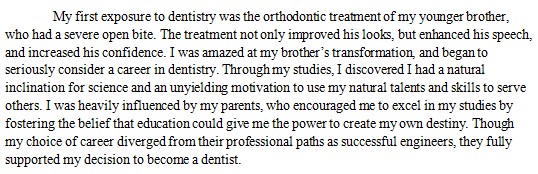
What themes did you gather through this paragraph? Often the theme you gather in the first paragraph is the one the applicant is trying to focus on, though this is not always the case. When reviewing this paragraph, it was clear the client had an important experience with his or her brother that deeply affected them. This theme was wordy and poorly transitioned though; things that will be corrected later. What about this next paragraph? Try to pull the theme from this one.
Pre-Edit: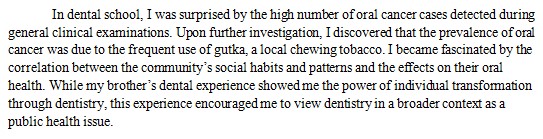
In this paragraph the author focused on the public health effects of good oral care, namely the use of chewing tobacco. Before we continue, let’s examine the next, more lengthy paragraph.
Pre-Edit: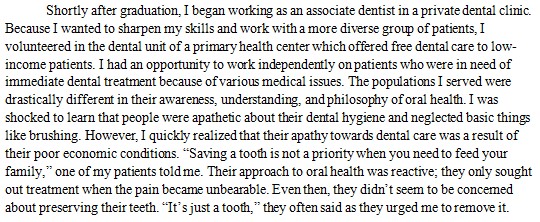
Here can be emphasized the importance of reading for themes. Much length can be saved by summarizing themes and thoughts into concise sentences. Reflect on the last two paragraphs for a moment and imagine how the theme of public health, along with the experience with their brother could be weaved together. NOW you’re making serious progress! Keep reading for themes through these next two paragraphs.
Pre-Edit:
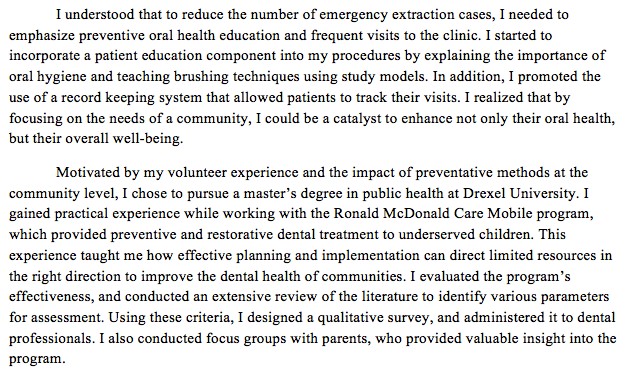
Here, the author continues to focus on the theme of public health but begins to include experiences that support this theme- another important skill. It is also important to recognize that self-promotion is a difficult skill for international applicants who are trying to play it safe by being conservative. Keep that in mind as you continue reading for themes through the next paragraph.
Pre Edit:
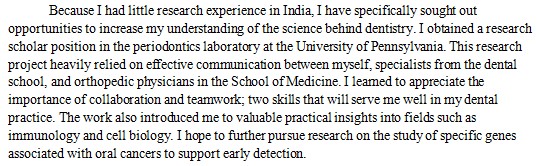
More self-promotion that comes just a bit too late in the author’s two-page SOP. There is a different theme present, however. The theme here is to try and share as many experiences as quickly as possible. It almost feels out of sync with the preceding paragraphs. Reading on, the final paragraph is finally here; if you feel tired imagine how the dental schools feel.
Pre Edit: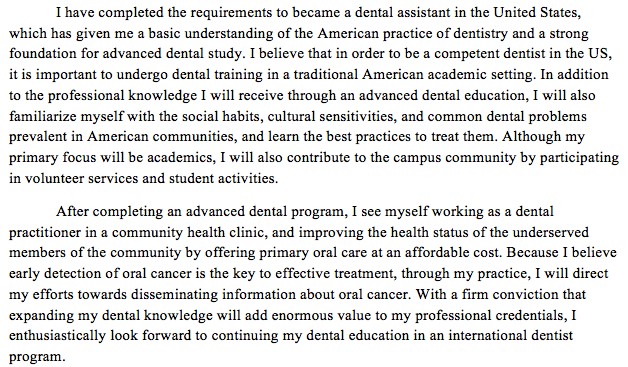
The final paragraphs lack a clear message or theme. It contains a smattering of general comments and half-hearted attempts to convince the reader of their passion for becoming a US trained dentist; something every applicant is trying to do. Instead of letting the reader make their own conclusion, the author attempts to tell them what to decide which is a common flaw in many SOPs. Using the themes we unveiled, we can help our authors avoid letting their conclusions become white noise by beginning to weave passion.
Weaving Passion
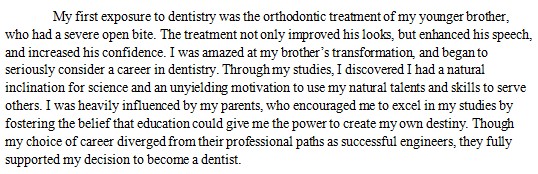
Take a breath, the hardest part is over. Finding the themes for these applicants is the most difficult part, but they serve as the scaffolding upon which we can build passion. If you were asked to write in a foreign language it would be difficult to exude passion without the help of a native speaker. Luckily, that’s where IDC comes in. Review the first paragraph, pre and post-edit, for an example of how to weave passion.
Pre Edit:
Post Edit:
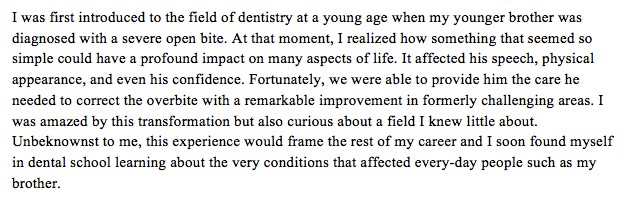
Dental schools get hundreds of candidates who talk about the same things and have the same repetitive themes. Their SOP is what makes them stand out, and several factors can help: genuine curiosity, thoughtful reflection, and internal drive. If you reflect on the previous paragraph all of these factors have been woven in around the theme delivered by the author. Let’s examine the next two paragraphs.
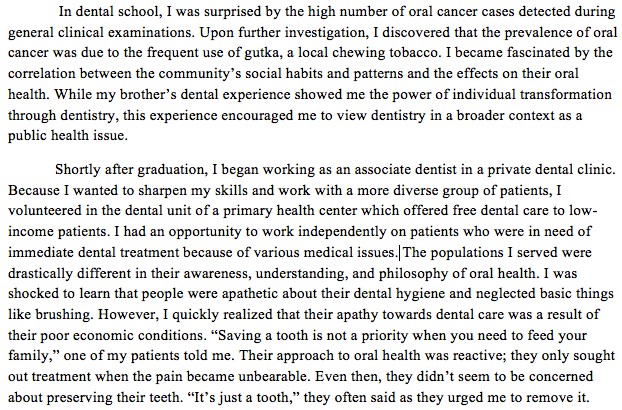
Pre Edit:
Post Edit:
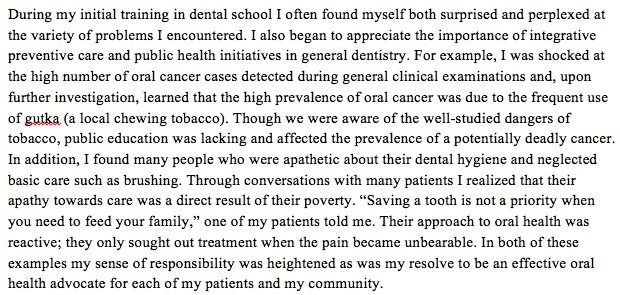
Again woven into this paragraph are things dental schools need to have an applicant stand out; curiosity to find problems, reflection on issues and experiences, and the internal drive to get things done. Nothing was made-up, created or embellished, just more clearly (and succinctly) stated. Weaving passion means beginning the true editing of a SOP and marks a turning point. As you begin, though, remember to apply the next principle and relate experiences. Passion is necessary, but without action it remains meaningless.
Relating Experience
International dentists have many experiences, often more than US dental applicants. As stated before, it is difficult for these applicants to walk the fine line between conceit and self-deprecation. Either they don’t share enough of their experiences or they share too many. How do we help them (and ourselves) avoid these common pitfalls?
Pre Edit:
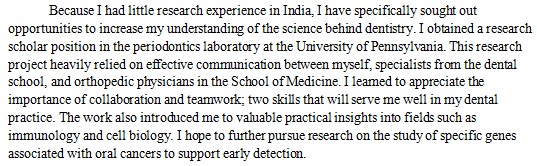
If you hadn’t already seen this paragraph several times you wouldn’t know it belonged to our SOP because there’s no theme injected into it. More importantly, however, is that these experiences aren’t tied to that theme. Instead, we have a paragraph outlining some of the incredible opportunities the author had in a smattering format. The reader gets needlessly lost in a maze of locations and details that break up the story like a bad joke. When faced with SOPs such as this I imagine the author reading their CV aloud with commentary. What we need to do, instead, is refer back to the themes and the passion we found prior and fold in the client’s unique experiences to enhance them. Most experiences can be tweaked one way or another to connect with the theme, but be wary of manufactured associations. If in doubt, contact the author for more details. Here is a summary statement of what the author was trying to get across in one sentence.
Post Edit:

Showing that this author has a multitude of experiences does, in fact, show a clear commitment to dental health and this summary statement demonstrates mature reflection. This author in particular demonstrated a clear commitment to public health as well. We see this more in an earlier paragraph, though it again gets lost in verbiage.
Pre Edit:
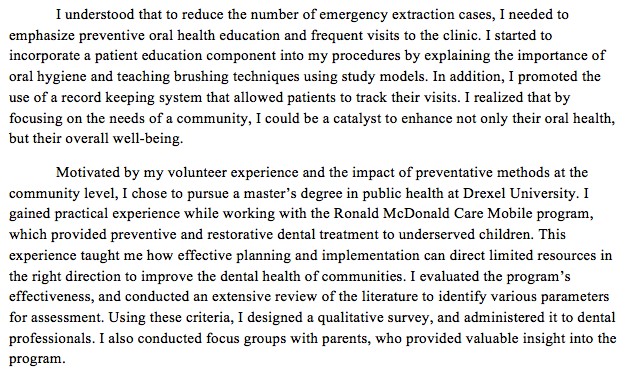
Here the theme gets lost in the second paragraph as the author again starts to commentate his or her CV. We don’t see the theme of the brother and only the theme of public health. By altering the flow of information and the focus of the text, we can create a more concise statement that ties everything together very nicely.
Post Edit:
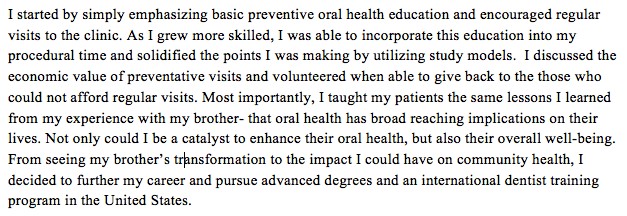
This statement even ties back to the ultimate goal of the SOP- answering the question “why”. This edit demonstrates the importance of remembering the purpose of the document you are writing and editing and the importance of keeping it tied together. It is very easy to get bogged down into an edit when you realize you have forgotten what the true focus of the document needs to be. This brings us to the final step in editing a SOP: the global perspective.
Global Perspective
So, you’re happy with your edit thus far. You’ve surveyed the scene, you found the themes, you wove in passion and supporting experiences, and you’re ready to submit.
WAIT!
Step away from the document for some time (I suggest at least an hour or two). You might have heard this suggested before, but let’s consider this scenario. You’re given a mission to find a specific shell on the beach. Most would begin their hunt by scanning the horizon for an area concentrated with shells, then commence their search. Painstakingly, they move their eyes from shell to shell searching for the prescribed one. Hours go by when you finally look up to see that you have been going in circles, making very little progress overall. Being methodical and planning can go a long way, but stepping back after time spent working on a tedious project is vital to ensuring you are on the right track.
Coming back with fresh eyes serves many purposes. Readability, flow, grammar, length, spelling, and vision all are more easily identified with a rested mind. Reviewing these factors shouldn’t be deferred for the finalized version and should be completed each and every time a revision is sent to a client. The SOP revision is our product and we want it to look and feel like quality.
Here are my 10 general tips for completing an effective global perspective:
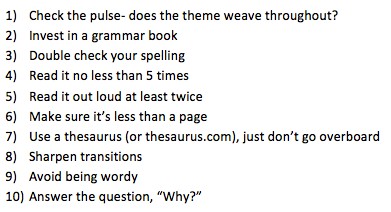
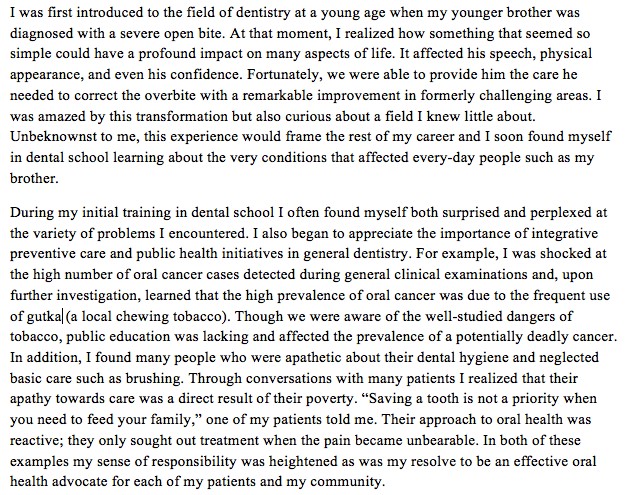
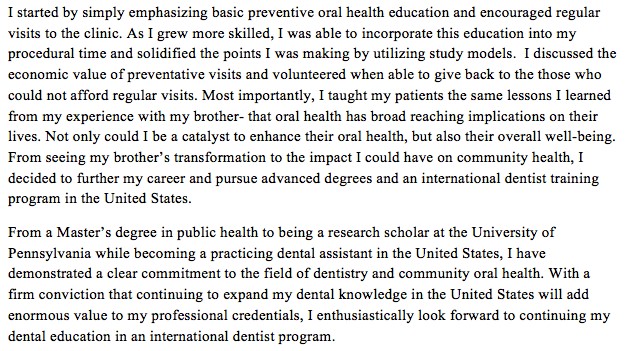
As you can see, the majority of the global perspective is comprised of what most think makes an editing session- though it is, in fact, the last step. Most will incorporate these tips into the previous steps but ensure when you have finished your edits you repeat them. This will help avoid more work on future revisions; again, saving you time and effort. Now that we’ve worked through the entire process, let’s take a look at the complete pre- and post-edit.
Pre-Edit:
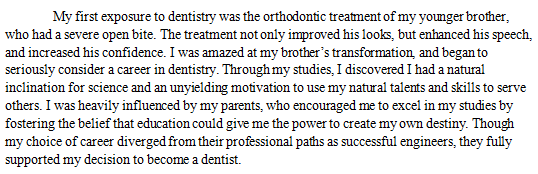
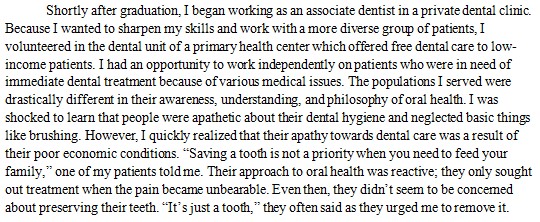
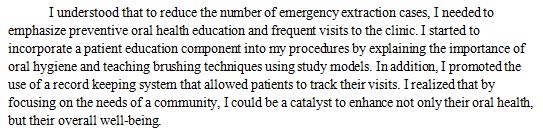
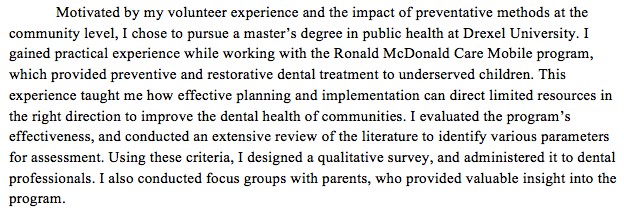
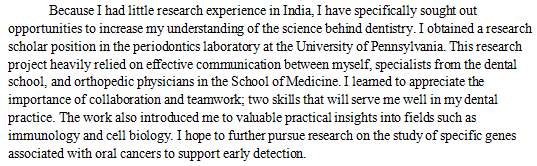
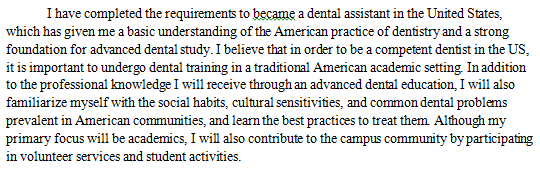
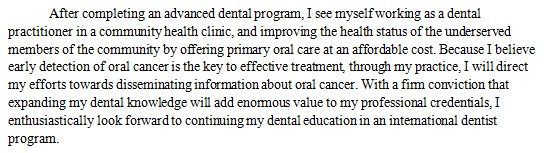
Post Edit:
Conclusion
Anyone can write a SOP, but writing a great SOP is what IDC is all about. The significant challenge we have is editing these SOPs while reflecting the unique clients that are represented by them. Extracting what makes them such good candidates while being brief and clear is difficult, but with these tools it can be easier. Surveying the scene provides us the context with which to develop a structure. Pulling themes provides that structure, and then combining the passion we identify from the applicants with their diverse experiences helps create the SOP dental schools want to read. Attention to details in grammar, structure, and overall flow help polish the final SOP into the perfect document our clients are looking for. With these steps we remove one more barrier for our clients in their path towards becoming a US trained dentist, and set ourselves apart as leaders in the international community.